The DV 2 engine is a two-spool low-bypass turbofan aviation engine designed for the extreme conditions of military jet trainers and light attack airplane operation. Demands on the engine for these airplanes are extensive, therefore requiring a design that is simple, robust, easy to maintain, has a low fuel consumption, low pilot’s workload, low operational costs on the one hand and high performance, good operational qualities, resistance to shock landings, surge, high operational load factors and high cycle load on the other hand.

The DV 2 engine meets and fulfils all these requirements. It was originally designed and now is produced for Aero L 59 (L 39 MS) jet advanced trainer and light attack airplane that entered service in the air forces of Slovak Republic, Czech Republic and of Egypt, in various climatic and operation conditions. High reliability, progressive form of maintenance – modular design and diagnostics system including borescope inspections, tribodiagnostics, vibrodiagnostics and engine monitoring, enables operators to maintain high operational readiness.
Basic Characteristics of the DV-2 Engine

  • Twin-spool turbofan engine with a medium bypass ratio designed to power trainer aircraft
  • Twin-rotor, twin-shaft engine with a coaxial rotor arrangement, featuring a front overhung fan equipped with a three-stage electronic-hydraulic control system
  • Modular construction allowing on-wing module replacement without the need for special adjustments
  • Advanced diagnostic system enabling lifecycle monitoring and fault prediction before they develop
  • High operational reliability and safety
  • Low operating costs, ease of maintenance, environmental friendliness

Engine Performance

Thrust, SFC / S/L, static, ISA

Rating Thrust (kN) Thrust (lbf) Time Limit SFC (kg/N/hr) [lb/lbf/hr]
Take-Off 21.58 4,850 20 minutes (available up to 24 °C / 75 °F) 0.0600 (0.588)
Nominal 17.46 3,930 no limitation 0.0594 (0.582)
Max. Cruise 14.62 3,290 no limitation 0.0588 (0.576)
Ground Idle 1.62 360 30 minutes
Maximum
H = 6 km / 19,700 ft; v = 700 km/h / 378 knot; ISA
12.75 2,870 20 minutes 0.0795 (0.779)

General Parameters

Parameter Value
Thrust (depending on engine variant)19 – 25 kN
Total Pressure Ratio18.3
Bypass Ratio1.46
Total Air Mass Flow49.5 kg/s (109.1 lb/sec)
Service Ceiling / Maximum Flight Levelmin. 13,000 m (42,700 ft)
Maximum Mach Number0.89
Maximum Operation Load+12 / −4 g
Dry Weight474 kg
TBO / Service Life500 / 1,500 h
Inverted Flight Time30 sec max. (repeatable after 10 s of other flight attitude)

Acceleration Time

Transition Condition Time
Idle → Take-Offup to H = 5 km4 to 7 sec
Idle → Take-Offover H = 5 km5 to 8 sec
Max. Cruise → Take-Off1.0 to 1.2 sec
Nominal → Take-Off0.6 to 2 sec

Design Features

TYPE: The DV 2 is a two-shaft low-bypass axial-flow fully aerobatics aviation turbofan engine.

INTAKE: Direct annular inlet with no inlet guide vanes of a 645 mm diameter. Conical spinner is air-heated with hot LP compressor bleed air for anti-icing.

FAN: The DV 2 has a single-stage supersonic fan with 15 wide-chord blades providing a high pressure ratio. It has a high resistance to bird strike and foreign object ingestion damage. Material and coating are designed for maximum resistance to corrosion and erosion.

COMPRESSOR: A two-stage subsonic axial-flow LP compressor is of disc-drum design and is connected to the fan disc by a common shaft and is followed by a seven-stage disc-drum HP compressor equipped with variable inlet guide vanes. The compressor is equipped with efficient anti-surging system.

COMBUSTOR: Annular type, ceramic coated.

TURBINE: A single-stage axial-flow highly efficient HP turbine with air-cooled vanes and blades drives the HP compressor while two-stage LP turbine with uncooled blades drives the LP compressor and the fan by concentric shafting. Maximum TIT is 1 464 K.

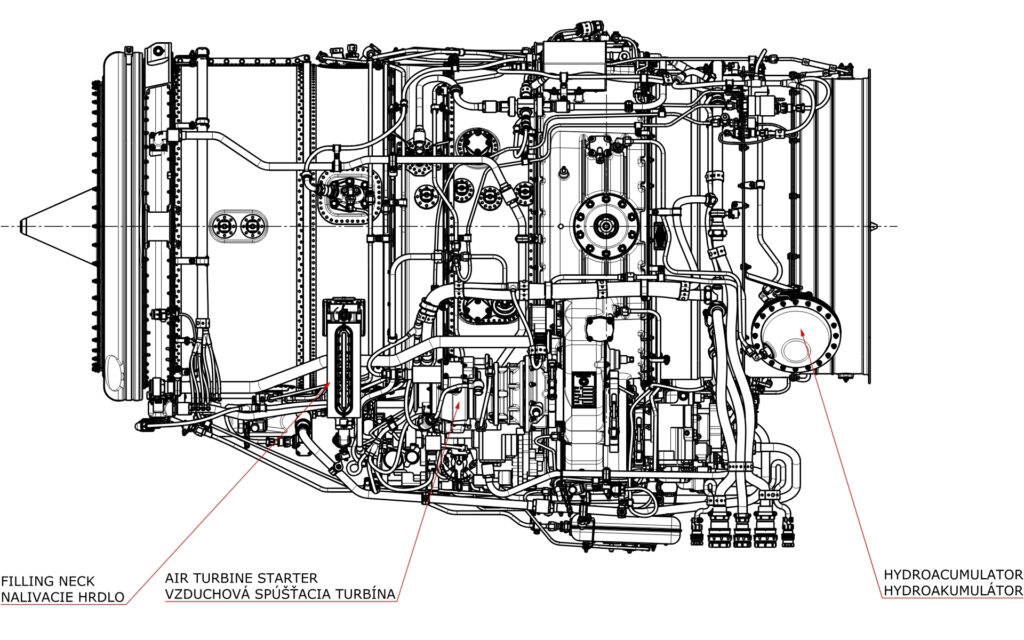
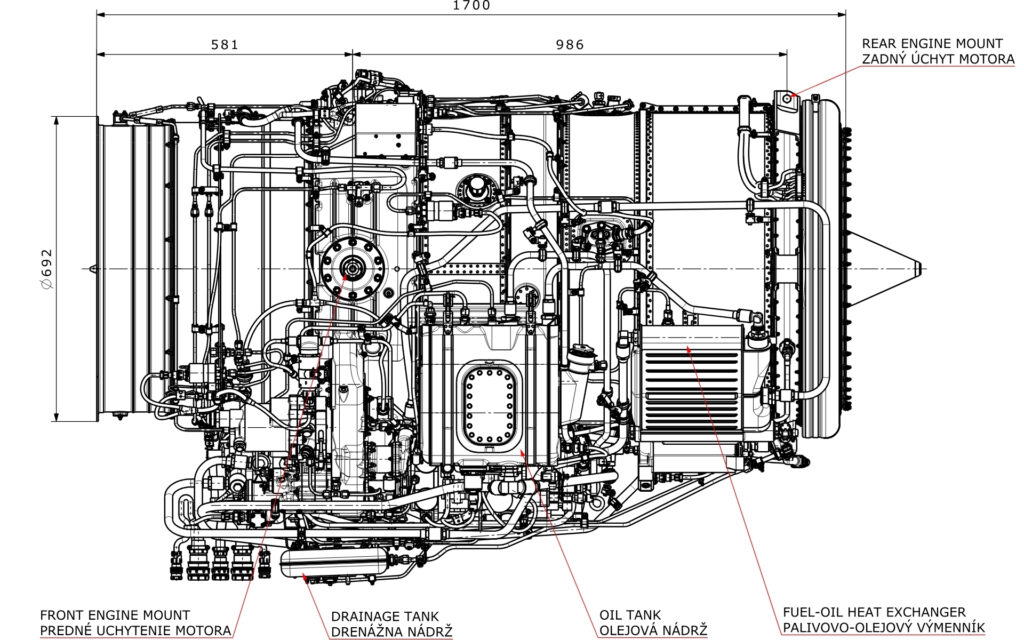
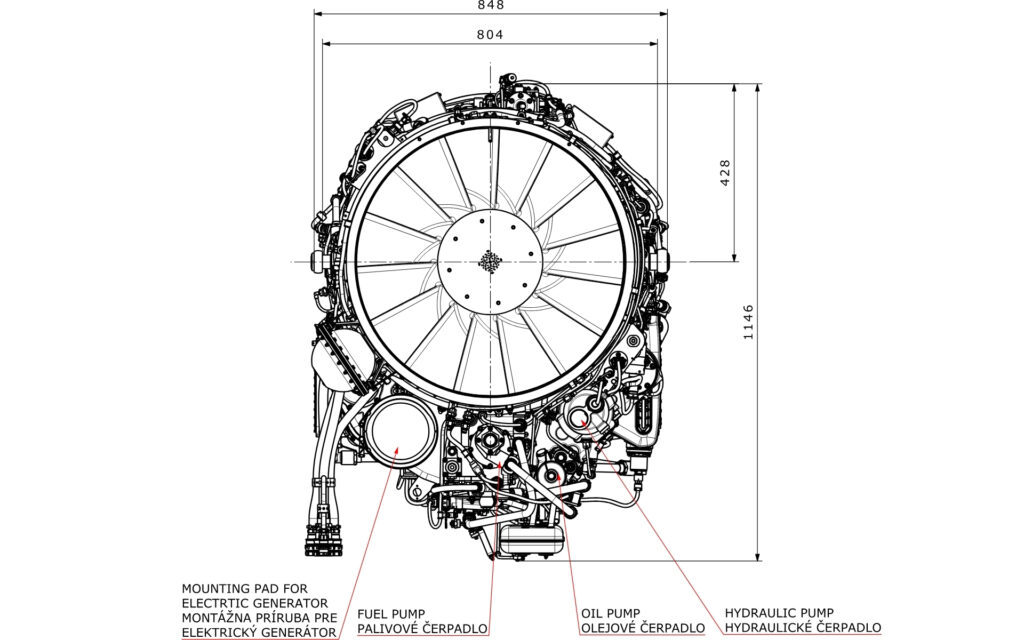
ACCESSORIES: Accessory drive gearbox, mounted under the intermediate casing, is driven from HP compressor shaft. Mounting pads are provided for two hydraulic pumps, generator, oil and fuel pumps and fuel control unit.

FUEL SYSTEM: Consists of electronic-hydromechanical primary channel and two hydromechanical and mechanical back-up channels.

OIL SYSTEM: Circular, closed, self-contained, aerobatics type.

STARTING SYSTEM: Starting is autonomous and automatized with a wide range of ambient temperature and altitude starting, and relight capability. The engine is fired up by using an air starting turbine driven by compressed air from aircraft APU.

Left Side View

Front View

Right Side View

Data brochure of the DV-2 engine